Singapore Customs
Guidance on controls, permits and restrictions for regulated goods and sanctioned trade activities.
Last updated 25 February 2026
Chewing Gum (HS Code 17041000)
The import of chewing gum classified under HS code 1704 1000 into Singapore is absolutely prohibited under the Regulation of Imports and Exports(Chewing Gum) Regulations. However, a trader is allowed to import chewing gum into Singapore (confined to FTZ(s) only) for re-export to any country, provided the trader registers with Singapore Customs as an importer and re-exporter of chewing gum and complies with the following conditions:
Furnish the Director-General of Customs with a letter of undertaking and
Lodge a Banker’s Guarantee with any Singapore registered bank for an amount SGD10,000 to Singapore Customs
Obtain a customs permit through TradeNet before the goods arrive in/depart from Singapore.
Submit the following documents together with the submission of the TradeNet declaration to obtain a permit:
Commercial invoice issued by supplier
Packing List
Airway Bill or Bill of Lading
Note: The permit application will only be processed after all the required documents have been submitted to Singapore Customs.
Import Certificate and Delivery Verification
The Import Certificate and Delivery Verification (ICDV) complement the export control regime of the foreign exporting country/region. Import Certificate serves as an assurance that the Singapore authority has no objection to the proposed import of the specific goods to Singapore for the stated end-use and to the stated end-user. Delivery Verification serves as an assurance that the goods have imported into Singapore.
It assures the exporting country that sensitive goods are delivered to approved end-users in Singapore, or that the goods are allowed to be re-exported through Singapore to approved end-users. The ICDV is also known as the International Import Certificate.
The ICDV is a 3-stage process:
Apply for an Import Certificate if:
The goods imported into Singapore are controlled by the exporting country, and
The exporting country requests for an Import Certificate
Obtain an import permit via TradeNet before importing the goods
Apply for a Delivery Verification after importing the goods, if the exporting country requests for such verification
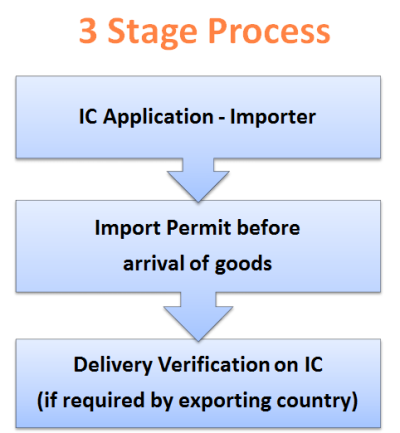
Three-step Import Certificate and Delivery Verification process.
Import of Mastering Equipment and Replication Equipment
The import of mastering equipment and replicating equipment for the manufacture of CD, CD-Rom, VCD, DVD and DVD-Rom are subject to control by Singapore Customs under the Regulation of Imports and Exports Regulations. The HS code for these controlled items is 8479 8969 while the 2 Product Codes are ‘Master’ or ‘Replicator’.
Approval to import these equipment for use in Singapore is also restricted to an approved manufacturer who has been issued a ‘Manufacturer Number’ by the Economic Development Board (EDB).
A customs permit must be obtained through TradeNet before the goods arrive in Singapore. If you intend to import these items, please refer to our Circular - I&E Notice No. 6/98 which is available from Customs website.
Kimberley Process Certification Scheme
What is it?
The Kimberley Process Certification Scheme (KPCS) is an international scheme to stop the trade of “conflict diamonds” and to ensure that diamond purchases do not finance violence by rebel movements and their allies seeking to undermine legitimate governments. Singapore has been a Kimberley Process (KP) participant since 2004.
Find out more about the KPCS and list of KP participants.
Importing and Exporting Rough Diamonds
To import rough diamonds under Harmonized System (HS) codes 7102 1000, 7102 2100 and or 7102 3100:
You must hold a valid KP Licence;
Your shipment must be sealed and secured;
Your shipment must be accompanied with a valid KP Certificate issued by the overseas exporting KP authority; and
You or your agent must produce the shipment, overseas KP Certificate issued by the overseas exporting KP authority, Customs import permit and supporting documents such as commercial invoice, packing list and Airway bill to the checkpoint officers at the time of importation for endorsement.
To export rough diamonds under HS codes 7102 1000, 7102 2100 and or 7102 3100:
You must hold a valid KP Licence;
Your shipment must be sealed and secured;
You must obtain a Singapore KP Certificate issued by Singapore Customs; and
You or your agent must produce the shipment, Singapore KP Certificate, export permit and supporting documents to the checkpoint officers at the time of exportation for endorsement.
Singapore Customs may conduct inspections on your import and export shipments of rough diamonds at our office or at any premises specified. For exports, the Singapore KP Certificate will only be issued when the inspection (if any) of the rough diamonds is found to be in order.
How to Apply for a Kimberley Process Licence?
Under the KPCS, a Kimberley Process (KP) Licence is required for the import and export of rough diamonds.
To apply for a KP Licence, you need to:
Register with the Accounting and Corporate Regulatory Authority (ACRA) to obtain a Unique Entity Number (UEN) account;
Activate your Customs account;
Have a valid Inter-Bank GIRO (IBG) account with Singapore Customs for the deduction of the annual licence fee (S$50 per year or part thereof);
Submit an Application for KP Licence through FormSG with all the supporting documents required (i.e. Business process flowchart, credentials of staff doing rough diamond processing work, website business profile of applicant etc).
The KP Licence expires on 31 December of the year in which it is issued and needs to be renewed annually thereafter. The renewal is subject to Customs’ review and assessment. Please refer to the KP Licence application form for the terms and conditions.
How to Apply for a Kimberley Process Certificate?
Under the KPCS, a KP Certificate issued by Singapore Customs is required for the export of rough diamonds.
To apply for a KP Certificate, you need to:
Have a valid KP Licence with Singapore Customs; and
Have a valid Inter-Bank GIRO (IBG) account with Singapore Customs for the deduction of a S$5 fee per KP Certificate issued; and
Submit the Application for KP Certificate through FormSG with all supporting documents (i.e. KP Licence, commercial invoice, packing list and Airway Bill etc); and ensure that you adhere to all the terms and conditions for the KP Certificate.
How to Apply for a Customs Permit
Customs permits are required for the importation and exportation of rough diamonds into or from Singapore.
You may:
Appoint a declaring agent to apply for Customs permits on your behalf; or
Apply for Customs permits on your own. To do so, you need to register as a declaring agent and apply for a TradeNet User ID.
All permit applications must be submitted via TradeNet, accessible through:
TradeNet front-end solution from any approved solution provider, or
If you choose to engage a declaring agent to assist you, you may wish to check with your appointed agent on the charges involved.
You or your appointed declaring agent is required to declare the following details in the permit application:
Description of goods – to declare origin, type, size, carat weight/mass and value of the rough diamonds
KP Licence Number – to declare in the ‘Licence’ field
KP Certificate Number (mandatory) and Seal Number of the parcel (if any) – to declare in the ‘Traders’ Remark’ field
Please submit the following documents together with the TradeNet declaration:
Commercial Invoice issued by the supplier
Packing List
Airway Bill
Copy of Singapore KP Certificate (for export permit applications) or KP Certificate issued by the overseas exporting KP Authority (For import permit applications)
Note: The permit application will only be processed after all the required documents have been submitted to Singapore Customs.
Controlled Chemicals
The Chemical Weapons Convention lists 3 schedules of toxic chemicals, their precursors and an additional category of chemicals known as unscheduled discrete organic chemicals (DOCs).
The schedules are organised to reflect the risk posed by the chemical to the objectives of the Convention, with decreasing risk across the schedules. Although DOCs are not directly related to making chemical agents, the facilities built for their production (with quantity exceeding threshold limits) can potentially be converted to chemical weapons production facilities.
Scheduled Chemicals
Overview of Chemical Weapons Convention (CWC) Schedules, Example Chemicals, and Typical Commercial Applications
Schedule | Description | Examples | Possible products categories |
|---|---|---|---|
1 | Schedule 1 covers chemicals that possess lethal or | Sarin |
|
2 | Schedule 2 covers chemicals which are potential chemical warfare agents (Schedule 2A and 2A*), | Methylphosphonyl dichloride |
|
3 | Schedule 3 covers chemicals which had previously | Triethanolamine |
|
See full list of scheduled chemicals.
Unscheduled Discrete Organic Chemicals (DOCs)
An unscheduled discrete organic chemical (DOCs) refers to any chemical that belongs to the class of chemical compounds consisting of all compounds of carbon, except for its oxides, sulfides and metal carbonates. It is identifiable by name, structural formula (if known), and Chemical Abstracts Service (CAS) Registry Number (if assigned). It excludes
Oligomers and polymers whether or not containing phosphorus, sulfur or fluorine
Chemicals containing only carbon and metal
Carbon monoxide and carbon dioxide (referred to as “oxides of carbon” in the above definition)
Carbon disulfide or carbonyl sulfide (referred to as “sulfides of carbon” in the above definition)
There are 2 types of DOCs
PSF-containing DOCs (Those that contain phosphorus, sulphur or fluorine)
Non PSF-containing DOCs (Those that do not contain phosphorus, sulphur or fluorine)
Determining if your product is controlled
Please refer to the list of scheduled chemicals to check if your product is controlled by the NA(CWC).
You may also check using the description of the goods, Harmonized System (HS) code or Competent Authority (CA) product code on this search engine. If the HS code is subject to control, the name of the CA and the chemical(s) that the CA controls will be indicated. You may check directly with the respective CAs on their licensing requirements.
If you require further assistance to determine if your product is controlled, please fill out the Product Enquiry Form under “Chemical Weapons Convention Forms” on the Customs Forms & Service Links page, and attach the relevant supporting documents (such as Safety Data Sheet and Certificate of Analysis).
The following information are required when filling out the form
Particulars of applicant
Activities involved
HS codes of product
Safety Data Sheet/Certificate of Analysis of product
Intended use of product
For submission of multiple files, please zip the documents and submit as a single file in the appropriate form. For files that are larger than 7MB, you may submit your supporting documents via email (customs_nacwc@customs.gov.sg).
Strategic Goods Control Overview
Singapore shares the concern of the international community on the proliferation of weapons of mass destruction, and recognises the need for safeguards against the illicit movement of items through its ports that can contribute to such proliferation.
As a responsible trading nation, Singapore implemented the Strategic Goods (Control) Act or SGCA on 1 January 2003 to regulate the trade in strategic goods and strategic goods technology.
Strategic goods refer to items and their related technology that can be used to produce weapons of mass destruction, and missiles capable of delivering such weapons. This includes arms and military equipment, and commercial items that can be used to develop weapons of mass destruction.
Singapore Customs is the National Authority to administer the SGCA. The functions carried out by Singapore Customs include:
Processing of strategic goods permit applications
Registering and auditing of arms brokers
Conducting industry outreach and public awareness programmes
Enforcing the SGCA and its regulations
Serving as the focal point for local and international enquiries
Singapore Customs also coordinates closely with other government agencies such as the Immigration and Checkpoints Authority and Singapore Police Force to enforce the SGCA.
United Nations Security Council Sanctions
The United Nations Security Council (UNSC) resolutions impose sanctions including prohibitions on activities relating to certain countries, goods and services, and/or entities (persons, companies or organisations).
As a member of the United Nations, Singapore implements the resolutions adopted by the UNSC. Specifically, the import into, export from, transhipment and transit through Singapore of certain goods which contravene the UNSC sanctions are prohibited under Regulation 6(1)(b) of the Regulation of Imports and Exports Regulations (RIER). A comprehensive list of UNSC sanctions can be found on the UNSC Sanctions Committees website.
Democratic People’s Republic of Korea (DPRK)
List of Prohibited Imports and (Inward) Transhipment or goods in Transit from the DPRK
List of Prohibited Exports and (Outward) Transhipment or goods in Transit to the DPRK
Permit Requirements
A permit is required if you intend to import, export, tranship and transit all goods through Singapore which are originating from or bound for the DPRK.
The import, export, transhipment or transit of any goods listed above are strictly prohibited under the Seventh Schedule of the RIER, read with Regulation 6(2)(c) of the RIER. This includes goods for the purposes of trade with any person in the DPRK.
For all non-prohibited goods arriving from or destined for the DPRK, you are required to apply for the permit at least 3 working days before the intended shipment date to or from Singapore. Please refer to the permit requirements for the import, export, transhipment and transit of goods through Singapore.
If your shipment is permitted under the exceptions outlined in the UNSC Resolutions, please also submit supporting documents to show that the shipment falls under the exceptions (e.g. a letter of authorisation issued by a United Nations programme).
Please submit the following supporting documents together with your permit application to Singapore Customs either via TradeNet® or via email to customs_stgc@customs.gov.sg for our verification:
Commercial invoice;
Bill of Lading/House Bill of Lading or Master Air Waybill/House Air Waybill;
Packing list;
Sales contract;
End-user certificate or statement; and
Other relevant supporting documents
Your application should be processed within 3 working days if all required information and documents are complete. However, processing times may be longer for certain applications, depending on the nature of the item, destination or parties involved in the transaction.
You are also reminded to comply with any stipulated permit conditions.
Islamic Republic of Iran
List of Prohibited Imports and (Inward), Transhipment or goods in Transit from Iran
List of Prohibited Exports and (Outward) Transhipment, or goods in Transit to Iran
Permit Requirements for UNSC Procurement Channel
Although nuclear-related items are prohibited from export or re-export to Iran, UNSC Resolution 2231(2015) endorsed the establishment of a dedicated “procurement channel” for the transfer of the nuclear-related items, materials, equipment, goods and technology to Iran. Through this procurement channel, the UNSC will allow certain exports of nuclear-related items to Iran if the UNSC has given their prior in-principle approval. The items which qualify for the procurement channel are:
Items listed under INFCIRC/254/Rev.13/Part 1; and
Items listed under INFCIRC/254/Rev.10/Part 2.
The documents can be accessed on the UNSC website at https://undocs.org/S/RES/2231(2015). The listed items are also controlled under the Strategic Goods (Control) Act, and require a strategic goods permit for the export, re-export, transhipment or transit from or via Singapore.
To seek the UNSC’s in-principle approval of such exports, you are required to submit a completed form and an end-user certification based on the templates provided by the UNSC to Customs. Customs will inform the UNSC of your request for in-principle approval. As the UNSC would take time to process your application, please submit them at least 2 months prior to the intended date of exportation.
For re-exports, transhipment, and transit of these items please ensure that approval has been obtained from the UNSC Procurement Channel. Proof of the UNSC Procurement Channel’s approval must be submitted together with your strategic goods permit application for the particular shipment.
The export, re-export, transhipment or transit of these items to Iran from Singapore without both a valid approval from the UNSC and a strategic goods permit from Singapore is an offence.
General Permit Requirements
With the exception of goods under the UNSC Procurement Channel, all other goods which are imported from, exported, re-exported, in transit or transhipment to Iran would require a permit to be applied for at least 3 working days before the intended shipment date to or from Singapore. Please refer to the permit requirements for the import, export, transhipment and transit of goods through Singapore.
If your shipment is permitted under the exceptions outlined in the UNSC Resolutions, please also submit supporting documents to show that the shipment falls under the exceptions (e.g. a letter of authorisation issued by a United Nations programme).
Please submit the following supporting documents together with your permit application to Singapore Customs either via TradeNet® or via email to customs_stgc@customs.gov.sg for our verification:
Commercial invoice;
Bill of Lading/House Bill of Lading or Master Air Waybill/House Air Waybill;
Packing list;
Sales contract;
End-user certificate; and
Other relevant supporting documents
Your application should be processed within 3 working days if all required information and documents are complete. However, processing times may be longer for certain applications, depending on the nature of the item, destination or parties involved in the transaction.
You are also reminded to comply with any stipulated permit conditions.
While Singapore does not enforce unilateral sanctions imposed by other countries, you may wish to conduct proper due diligence checks to ensure that your business is not at risk. Where legal advice is required, please seek advice from your legal advisors.
Other Countries pursuant to UNSC Sanctions or Regulations
Permit Requirements
To import, export, tranship or transit goods permitted under the exceptions or exclusions outlined in the UNSC Resolutions, you are required obtain for a permit via TradeNet before the intended shipment date from or to Singapore.
Please refer to the permit requirements for the import, export, transhipment and transit of goods through Singapore.
If your shipment is permitted under the exceptions outlined in the UNSC Resolutions, please also submit supporting documents to show that the shipment falls under the exceptions (e.g. a letter of authorisation issued by a United Nations programme).
You are required to apply for a permit at least 3 working days before the intended shipment date to or from Singapore. The permit requirements to import, export, tranship and transit goods through Singapore still apply.
Please submit the following supporting documents together with your permit application to Singapore Customs either via TradeNet® or via email to customs_stgc@customs.gov.sg for our verification:
Commercial invoice;
Bill of Lading/House Bill of Lading or Master Air Waybill/House Air Waybill;
Packing list;
Sales contract;
End-user certificate; and
Other relevant supporting documents
Your application should be processed within 3 working days if all required information and documents are complete. However, processing times may be longer for certain applications, depending on the nature of the item, destination or parties involved in the transaction.
Please note that Singapore does not enforce unilateral sanctions imposed by other countries. You are advised to look out for red flags to ensure your trading activities comply with Singapore’s domestic laws and the UNSC Resolutions.