Strategic Goods Control Overview
Learn what strategic goods are, why they matter, and how Singapore Customs upholds strong controls to ensure Singapore remains a responsible and secure global trading nation.
Last updated 11 March 2026
Overview
Singapore shares the concern of the global community on the proliferation of weapons of mass destruction (WMD). As a major trading hub, we recognise the need for safeguards against the illicit movement of items through our ports that could support such activities.
As a responsible trading nation, Singapore implemented the Strategic Goods (Control) Act (SGCA) on 1 January 2003. The SGCA regulates the transfer and brokering of strategic goods and related technologies.
What are Strategic Goods?
Strategic goods refer to items and technology that can be used to produce WMD and missiles capable of delivering them. This covers:
Arms and military equipment
Dual-use commercial items that may be adapted for harmful purposes
.png)
A practical visual guide to help businesses understand which goods, software, or technical data may be subject to strategic goods control and what factors determine whether approval is needed.
Download the Infographic in [PDF, 3 MB] to view the linked resources.
Our Role as the National Authority
Singapore Customs administers the SGCA and works closely with industry stakeholders to ensure compliance. Our key responsibilities include:
Processing strategic goods permit applications
Registering and auditing arms brokers
Conducting industry outreach and awareness programmes
Enforcing the SGCA and its related regulations
Serving as the main point of contact for local and international enquiries
We also actively collaborate with other enforcement agencies, such as the Immigration & Checkpoints Authority and the Singapore Police Force, to maintain a strong, coordinated national control system.
Legislation
Singapore’s regulatory controls on strategic goods are governed by the Strategic Goods (Control) Act and its subsidiary legislation, providing a comprehensive legal framework for regulating the transfer, and brokering of strategic goods and related technologies.
Strategic Goods (Control) Act
The Strategic Goods (Control) Act (SGCA) regulates the export, transhipment, transit, intangible transfer of technology, and brokering of strategic goods and technologies. It includes a “catch-all” provision, ensuring that any goods and technology intended, or likely, to be used for WMD purposes are subject to regulatory control.
Subsidiary Legislation
Strategic Goods (Control) Regulations
The Strategic Goods (Control) Regulations (SGCR) provide procedural guidelines for implementing the SGCA effectively, covering permit application procedures for legitimate trade activities and the conditions for approving, suspending, or revoking permits.
Strategic Goods (Control) Order 2025
The Strategic Goods (Control) Order 2025, effective 1 December 2025, provides the list of strategic goods and related technologies controlled under the SGCA.
Detailed changes are available in the amendment table.
For guidance, visit our Frequently Asked Questions on these updates.
Strategic Goods (Control) (Brokering) Order
The Strategic Goods (Control) (Brokering) Order 2019 lists the categories of goods and technologies that require brokering registration under the SGCA.
Useful Resources
Note: Legislation is reproduced with permission from the Government of Singapore. Acts of Parliament are available for free and updated monthly at the Singapore Government Statutes Online. Hard copies can be purchased from Toppan Next Pte Ltd.
Scope of Control
The Strategic Goods (Control) Act (SGCA) regulates the transfer, and brokering of strategic goods and strategic goods technologies. It includes a “catch-all” provision where goods and technology intended or likely to be used for WMD will be subject to controls, meaning any goods or technology that may be used in relation to WMD activities are automatically controlled, even if they are not specifically listed.
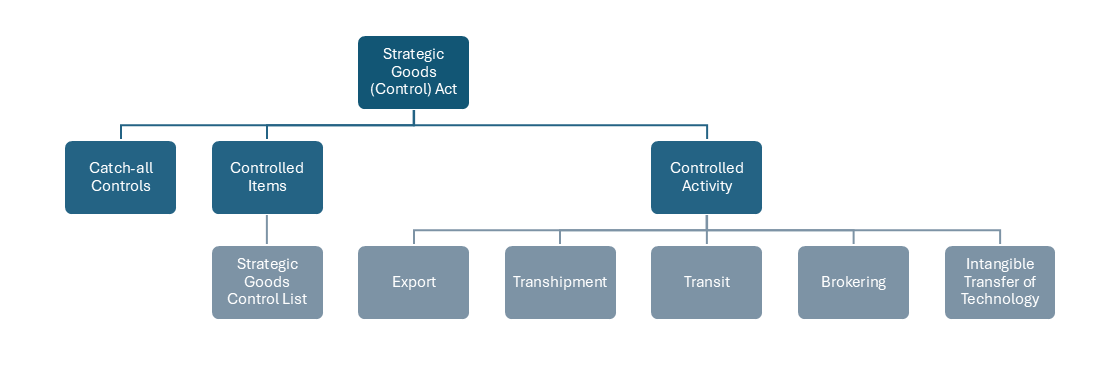
Overview of controls under the Strategic Goods (Control) Act.
Controlled Items & Catch-all Controls
The Strategic Goods Control List specifies the items that are regulated under the SGCA. If an item appears on this list, it is subject to strategic goods controls.
In addition to the list, the SGCA includes a broad “catch-all” provision. This means that any goods or technology that are intended, or even likely, to be used for WMD activities are subject to control, even if they are not explicitly listed.
Controlled Activities
The SGCA governs the transfer and brokering of:
Strategic goods,
Strategic goods technology, and
Any other goods or technology that can support the development, production, operation, stockpiling, or acquisition of WMDs, and missiles capable of delivering them.
Below are the key activity types controlled under the SGCA:
Export
Goods taken out of Singapore by land, water, or air, and includes the placing of the goods in a conveyance for the purpose of taking it out of Singapore. It does not include the taking out from Singapore of goods that have been brought in transit or transhipped.
For more information, refer to Individual Permit: Export, Transhipment and Transit.
Transhipment
Goods removed from the conveyance that were brought into Singapore, and subsequently placed on the same or another conveyance for the purpose of taking them out of Singapore. These acts are carried out on a through bill of lading, through air waybill or through manifest without being consigned to a local party.
For more information, refer to Individual Permit: Export, Transhipment and Transit
Transit
Goods brought into Singapore, and subsequently taken out from Singapore on the same conveyance they are brought into Singapore. These acts are carried out on a through bill of lading, through air waybill or through manifest, without being consigned to a local party. Goods brought in transit are not unloaded and remain on board the conveyance.
For more information, refer to Individual Permit: Export, Transhipment, Transit.
Intangible Transfer of Technology (ITT)
Any electronic transmission of controlled strategic goods technology in Singapore, such as via email or fax, or the act of making the controlled technology available on a computer in Singapore so that it becomes accessible to a person in a foreign country.
For more information, refer to Intangible Transfer of Technology (ITT).
Brokering
Arranging, negotiating, or carrying out any act to facilitate the arrangement or negotiation of a contract to acquire or dispose of any controlled goods or technology if that person knows or has reason to believe that such a contract will or is likely to result in the removal of those goods and technology from one foreign country to another foreign country.
If you engage in any of the above activities involving strategic goods or strategic goods technology, you must comply with the SGCA’s permit and registration requirements.
Enforcement
Singapore Customs plays a vital role in safeguarding secure and responsible trade. To ensure that all transfers of strategic goods and strategic goods technology are legitimate, Customs officers conduct regular checks on trader activities.
These checks include documentary reviews and audits of past shipments, as well as physical inspections of suspicious cargo at entry and exit points and within free trade zones. Enforcement actions are guided by specific intelligence and risk profiling, enabling officers to detect, deter, and address potential violations effectively.
Singapore also works closely with international partners to share intelligence and exchange information on strategic goods offences, in accordance with the laws of the respective countries. Customs takes a firm position on non-compliance and will not hesitate to take enforcement action when offences are detected.
If you are involved in activities relating to the transfer or brokering of strategic goods or related technology, you are reminded to exercise due diligence. To ensure compliance with the Strategic Goods (Control) Act (SGCA), businesses are advised to implement an internal compliance programme as outlined in the Strategic Trade Scheme Handbook.
Members of the public who have information on illegal dealings involving strategic goods or strategic goods technology are encouraged to report them to Singapore Customs.
Examples of common offences
Transferring strategic goods without a valid strategic goods permit
Wrongly assuming that an export licence exemption in another country automatically applies in Singapore
Making a false declaration in permit applications
Declaring an incorrect Strategic Goods Product Code
Breaching the conditions of a permit or registration
Highlights of Enforcement Cases
Providing material support to a foreign terrorist organisation
A Singaporean man was convicted in the United States for conspiring to provide material support to a foreign terrorist organisation. He attempted to purchase arms and ammunition, an offence under Section 6(2)(b)(ii) of the SGCA. Following an extradition request by the US Government, the Singapore court ordered his extradition. He was sentenced to a 57-month prison sentence in the United States.
Submission of false permit applications
A freight forwarding company exported controlled military electronic connectors without a valid strategic goods permit and falsely declared them as ordinary connectors. The company was prosecuted and fined under Section 5(1)(a) of the SGCA. (Media Release)
Failure to register as a broker
A company arranged for the removal of expired and damaged ammunition from one foreign country to another for disposal, without registering as a broker with Singapore Customs. The company paid a composition sum for an offence under Section 6(1)(a) of the SGCA.
In another case, two individuals were sentenced to 9 and 18 months’ imprisonment respectively for brokering arms to Syria. (Media Release).
Key Offences
Penalties under the SGCA may include seizure and forfeiture of goods, fines, and imprisonment. Singapore Customs may offer to compound offences for a sum not exceeding S$10,000 per offence.
Table of Offences and Penalties under the Strategic Goods (Control) Act (SGCA).
Offence | Penalty Upon Conviction |
|---|---|
Transfer of strategic goods without a valid strategic goods permit | First conviction: |
Brokering of strategic goods without registration | Second or subsequent conviction: |
Breach of permit or registration conditions | Fine up to S$50,000, or imprisonment up to 12 months, or both. |
Companies which violate any regulatory requirement relating to SGCA may also face enforcement action under the Customs Act, the Regulation of Imports and Exports Act (RIEA), and the Chemical Weapons (Prohibition) Act (CWPA).
For more details, refer to the list of prescribed offences and penalties under the Customs Act, SGCA, RIEA and CWPA.